Using the Takeoffs Screen
Let’s start with a quick note on why we built this screen the way we did.
We wanted it to be clean, easy on your eyes, and enjoyable to work in. Everything is collapsible so you can stay focused and avoid that overwhelming feeling of too much on the screen at once. The goal is to help you stay locked in on one section at a time,
complete it, collapse it, and move on.
Now let’s walk through how to navigate this page.
Navigating the Takeoffs Screen
When you first open this screen, you will see your landscape work areas like the Patio Area and the Garden Area in our example. Each work area has a list of sections beneath it, and they’ll all be collapsed by default to keep things tidy.
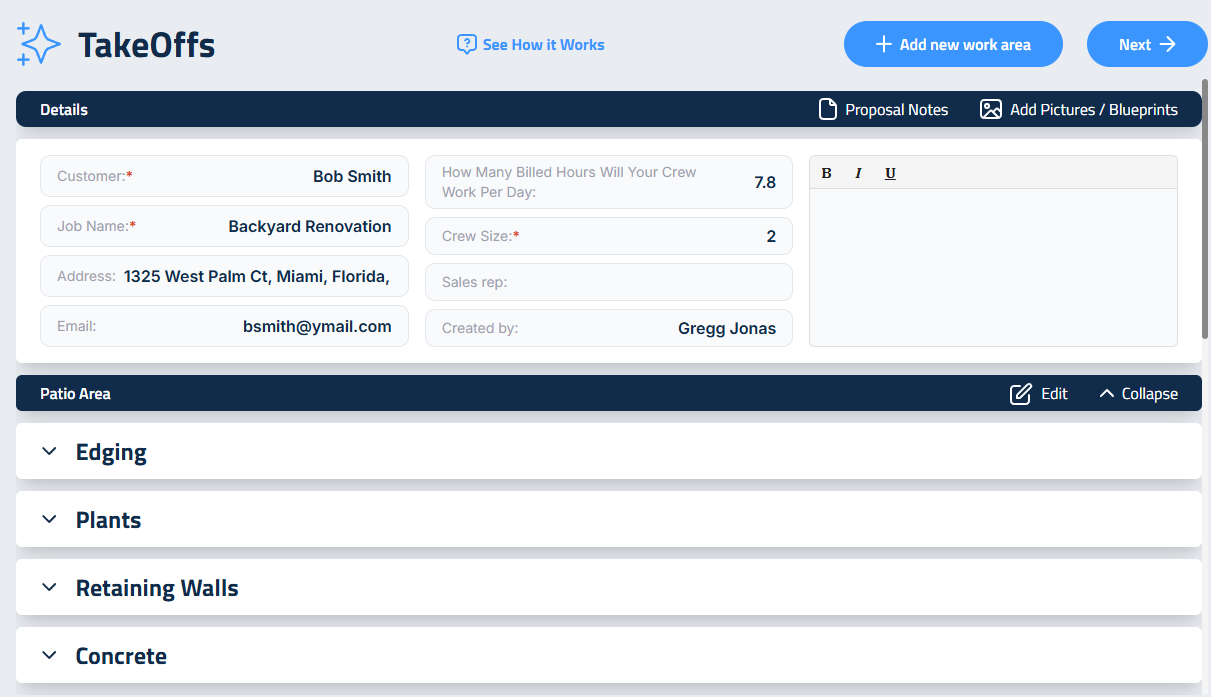
Click the top of the section or arrow icon to the left of any section to expand it. Click it again to collapse it. You can also collapse or expand the entire work area
using the “Collapse Area” button on the far right.
Editing Landscape Work Areas
If you click the Edit button for any work area, you can do a few things:
- Rename the work area
- Add or remove sections
- Delete the work area entirely
- And group multiple sections together using a custom group, which we’ll go over in a moment
To remove a section, just scroll to the bottom of e sidebar and click the red X next to the one you want to remove. To add a section, click on the name in the Section Library and it will move into the Included Sections area below.
To rename a work area, click “Edit Name” at the top of the edit sidebar, type in the new name, and hit Save. And to delete a work area entirely, scroll to the very bottom of the sidebar and click Delete Area. This will remove the entire work area and all of its included sections from the proposal.
And remember, after making any change here, you will need to hit Save for those changes to take effect.
Organizing Templates
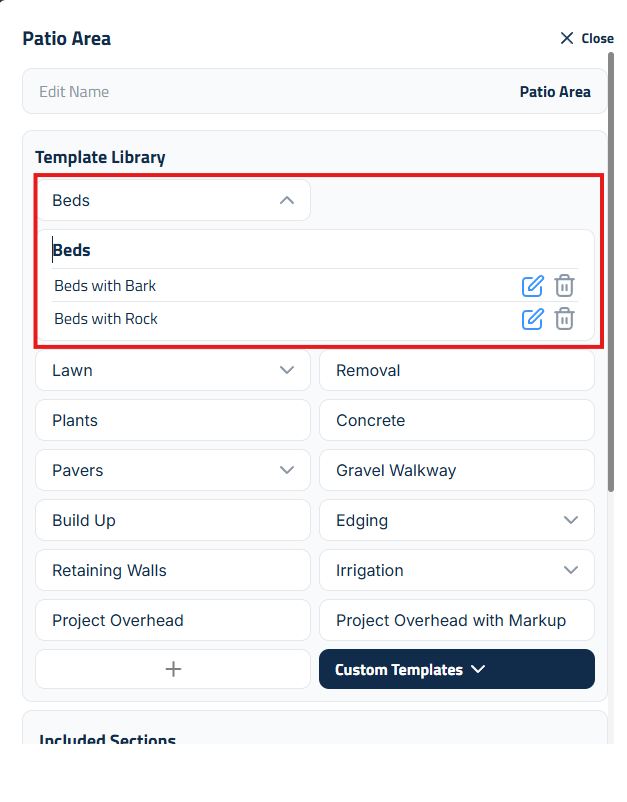
For example, templates for Beds might include:
- Beds with Bark
- Beds with Weed Fabric and Rock
Templates for Lawn might include:
- Lawn with Sod
- Lawn with Hydroseed
Once you’ve created and saved those templates, they’ll show up in the dropdown for that section. For any custom templates that don’t fall into a standard category
like Water Features, Fire Pits, or Raised Garden Beds, you will find those under the Custom Templates button.
If you don’t see a template where you expect it, it probably hasn’t been saved yet.
Reordering Sections
You can rearrange your sections by simply clicking and dragging them. For example, you want Removal listed before Build-Up, just drag it up. This gives you full control over the flow of your estimate and keeps your process smooth.
Now for this example bid, we’re going to organize the sections in the order we plan to teach and present them not necessarily install order. We’ve arranged them here in the order that we teach but think about how you want to present each section to your client. The order you use here will be how it is displayed to your client.
Creating Custom Groups (ISPS System Feature)
Custom Groups are one of the most strategic tools within Elevation Advisor’s ISPS system (Integrated Sales Psychology and Strategies). They allow you to bundle multiple proposal sections into a single group that displays a lump sum price to the client, ideal for streamlining presentation and focusing on outcomes rather than itemized costs.
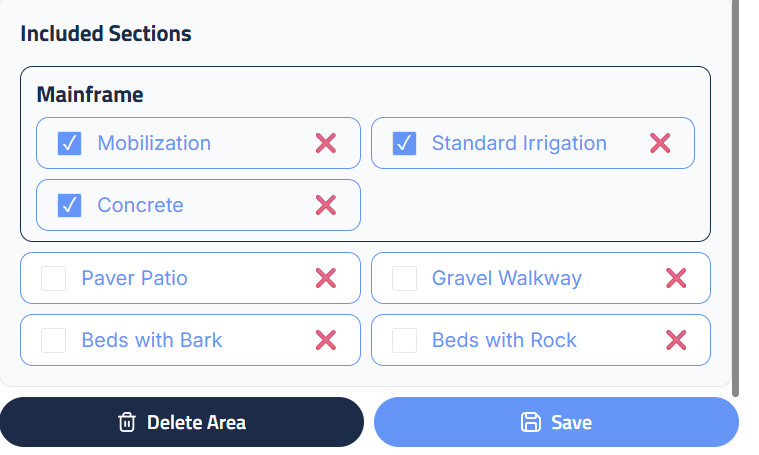
Purpose & Client View
- Each section within the Custom Group remains visible to the client.
- Pricing is shown as a single combined value, no individual line items are listed.
Let’s walk through creating a Custom Group using the following sections:
- Beds
- Lawn
- Build-Up
- Removal
- Project Overhead
- Irrigation
How to Build It
Select Sections
- Click the checkbox next to each section name you want to include.
- As you select them, they’ll automatically move into the Custom Group area at the top of your proposal workspace.
Rename the Group:
- Double-click the Custom Group header to rename it.
- In this example, we’ll name it Mainframe, but feel free to choose a name that matches your branding, internal terminology, or client communication style.
Save Your Changes:
- After entering your custom name, press Enter and then click Save to finalize and lock in the group.
Renaming Proposal Sections for Style and Branding
Customizing section names helps align your proposals with your brand voice, internal language, and how you communicate value to clients. Let’s walk through renaming a section using Project Overhead as our example.
How to Rename a Section
Expand the Section:
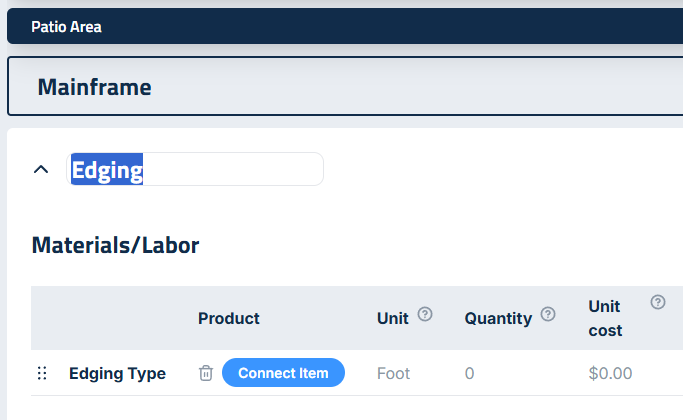
- Click the arrow next to Project Overhead on the left-hand side to open the section panel.
Edit the Section Name
- At the top of the panel, double-click the name Project Overhead.
- Type in your preferred name, for this example, we’ll use Mobilization, which feels more professional and client-oriented.
Confirm the Update:
- Once renamed, the new title will automatically update across the proposal view.
Saving, and Working From More Than One Place
Proposals get built in awkward ways. You start one at the office, finish it on a laptop at the kitchen table, and leave the office tab open all night. Elevation Advisor keeps that from costing you work. This applies everywhere you edit a proposal: Takeoffs, Markup, and Packages.
Your page keeps itself current. While a proposal is open, the page quietly checks whether anyone has saved it somewhere else. If your estimator saved from their laptop, or you saved from your phone, the page reloads with the newer version and a blue bar at the top telling you what happened. Click Dismiss when you’ve read it.
Every button saves what is on your screen. Next, Go Back, See Packages, Preview and the header fields all save the proposal as it stands in front of you, not a copy from when the page opened.
A save that would erase newer work is refused. If you save from a page that has fallen behind, you’ll see a message like "Your changes didn’t save because Sara changed this proposal 10 minutes ago on a laptop. The page now shows the latest version." The wording adapts to what actually happened: another tab in your own browser, you on a different device, or a teammate by name, with the device and timing when they’re known. The newer work stays, and you’re now looking at it. Make your edits again on the current version.
Trying to send from a stale page gives you the same protection: "This proposal wasn’t sent because someone else changed this proposal. Reload the page to see the latest version, then send again." That one matters more than it looks. It’s what stops a client receiving a proposal that’s missing the change your partner made an hour ago.
Version history. Click Version history, the clock icon in the toolbar next to Add Photos/Documents, to see where a proposal has been.
Saves are grouped into sittings, so you get readable entries rather than hundreds of individual saves. Each entry shows who saved it, the computer and browser they used, the time range, how many saves it covers, and what the line items added up to at that point, like "Thu, Sep 24 2:14 PM to 2:21 PM · 5 saves · Line items $61,685.56".
Click an entry to open it. You get a short list of what moved between that entry and the one before it, such as Line items changed, a renamed job, or a jump in the total written out as "Line items $61,685.56 → $55,000.00". If the entry holds more than one save, Each save lists them by the second, with its own line item total beside each one.
The newest save is always an entry of its own, marked Current. The original is labeled First save. A big jump in the line item total also starts its own entry, so a large deletion is never buried inside a sitting.
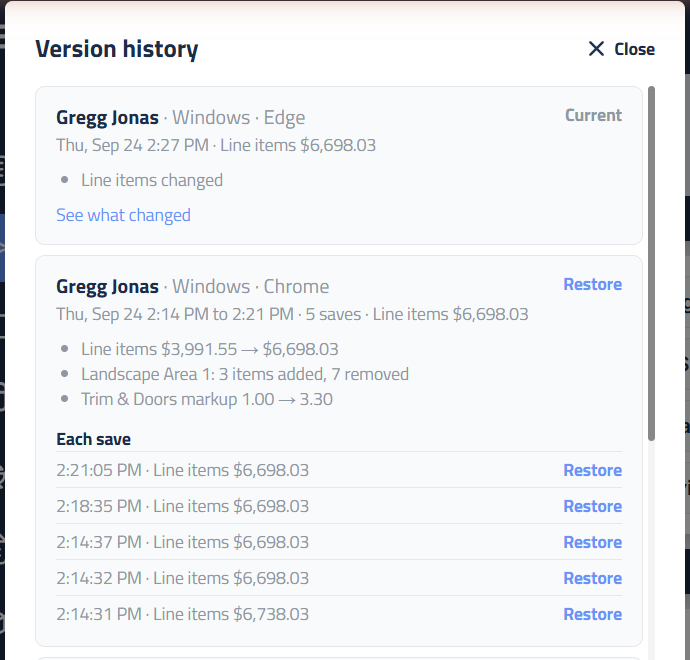
Click Restore to put a version back. It sits on every entry except Current, and on every individual save inside an opened entry, so you can land on the exact save you want rather than the nearest sitting. The restored version becomes the current one, is recorded as its own entry reading "Restored the version from...", and can itself be undone the same way.
Accepted proposals are locked, so their history can be read but not restored. Use a change order instead.
From expanding and collapsing sections to renaming and reordering, Elevation Advisor is designed to keep you focused and in control, one step at a time.
Updated on: 09/30/2026
Thank you!